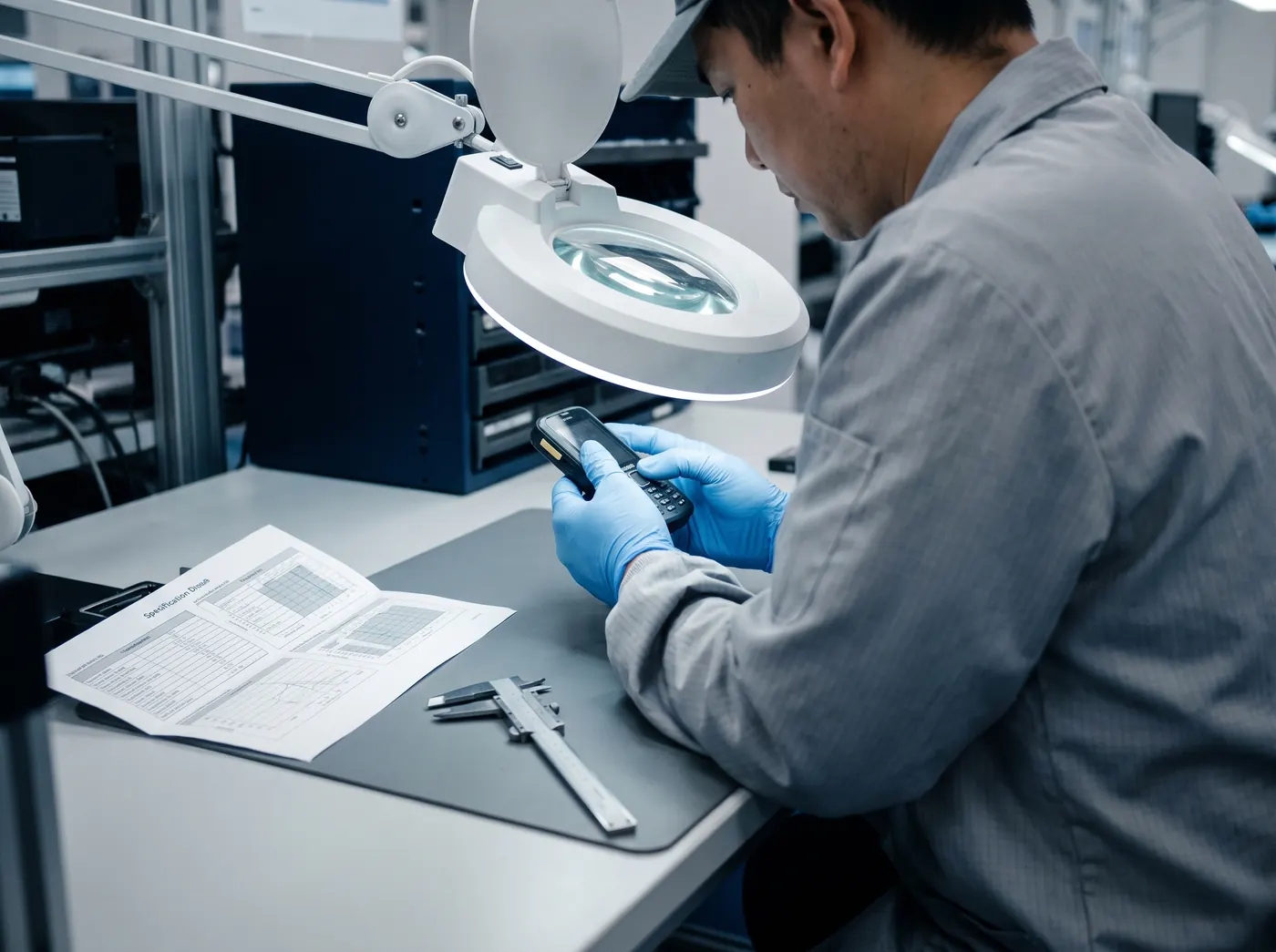

Shenzhen · buyer-side sourcing
We verify Chinese factories before you pay them.
Buyer-side technical sourcing in Shenzhen for West African importers. We work inside Chinese manufacturing on the buyer’s side of the table — establishing which companies actually manufacture, what they actually make, and what they have actually quoted.
- Manufacturers assessed
- 23
- Products captured
- 19
- Specifications translated
- 244
From the engagement running now — a body-worn camera programme for a Nigerian importer.
What goes wrong
Three things a buyer is handed instead of an answer
None of these is unusual, and none of them is dishonest on its face. Each one is a real finding from the work running now.
A supplier list is not verification
Anyone can return a page of marketplace links. A list says a company exists, not that it manufactures, not that it holds a business licence covering what it sells, and not that it is entitled to export.
From the recordTwo separately listed companies resolved to the same firm once their web domains were normalised, so two quotations that looked independent were one.
A quotation without terms is not a price
A figure sent in a message is not something a buyer can plan against. A quotation states the volume it applies to, the incoterm, the lead time and the date it stops being true — in writing.
From the recordThree prices were captured from chat messages with no minimum order quantity, no lead time and no validity period. They are recorded as indicative, and never as quotations.
The unit price is not the cost
A device that needs a dock, a licensed platform and somewhere to keep its footage is not priced by the device. The cheapest unit on a list is regularly the most expensive thing in the room.
From the recordOn the current engagement the costs behind the unit price include docking, platform licences, cloud retention, freight, duty and certification — each identified and priced separately.
What we actually do
Six stages, in order
The sequence is the product. Skipping a stage does not save time; it moves the discovery to the point where a container has already been paid for.
- 01
Identify
Candidate manufacturers are found against your requirement rather than taken from a marketplace shortlist, and assessed before any of them is put in front of you.
- 02
Verify
Which of them is a genuine factory rather than a trading company. Business licences and export entitlement are checked against documents, not against claims.
- 03
Specify
Specifications are collected in Chinese and translated, then recorded attribute by attribute — so that two products can be compared on the same fields.
- 04
Quote
Written quotations at your own volumes, on a stated incoterm, with the minimum order quantity, the lead time and the validity period on the page.
- 05
Compare
Attribute by attribute against your requirements, with the costs behind the unit price identified: docking, platform licences, cloud retention, freight, duty, certification.
- 06
Recommend
A recommendation with the evidence attached. Every finding carries who checked it, when, and against which document — including the ones that count against a supplier we like.
Where we stand
You contract with the manufacturer and you pay them directly.
We do not take title to the goods and we are not an agent for any factory, which is what allows a finding to go against a supplier without costing us anything.
Findings from the engagement running now
What checking actually turns up
These are the findings themselves, not a summary of them.
The ground covered
Manufacturers identified and assessed
23
Twenty-three Chinese manufacturers were identified and assessed for a single body-worn camera programme. Assessment is not a shortlist: it is the point at which a company stops being a search result and becomes something we can say a sentence about with a document behind it.
Specifications translated from Chinese
244
Nineteen products captured and recorded attribute by attribute, translated from Chinese — so a comparison runs on fields rather than on marketing copy.
What the checking turned up
- 1
Production sits elsewhere
One company disclosed under direct questioning that production actually sits with a different firm entirely. That answer produced a new manufacturer lead, which is the second reason to ask the question.
- 2
One firm, listed twice
Two separately listed companies resolved to the same firm once their web domains were normalised. Two “independent” quotations were not independent.
- 2
Identical specifications, different part numbers
Two models were found published with identical specifications under different part numbers — a distinction a comparison table would otherwise have carried as a real difference between products.
- 1
Two chipsets, one unit
One quotation named two different chipsets for the same unit. Until that is resolved in writing, nobody knows which device the price refers to.
- 3
Prices with no terms attached
Three prices were captured from chat messages with no minimum order quantity, no lead time and no validity period stated. They are recorded as indicative, and are never presented as quotations.

The client portal
Every finding carries who checked it, when, and against which document
One workspace for the duration of the engagement. A checkpoint that has not been examined reads as unexamined — never as a pass, and never as a failure.
What it holds
- Factories, with the evidence behind each one
- Verification checkpoints, including the unexamined ones
- Translated specifications, attribute by attribute
- Quotations, with the terms they were given under
- Stage progress across the whole engagement
Supplier identities, findings and quoted pricing are confidential to one client and are not shared between engagements.
Before you pay a factory, know who they are.
Tell us what you intend to import and at what volume, and we will tell you what verifying it involves — the stages, what each one produces, and what it cannot answer.
We are based in Shenzhen and we work for the buyer. More about the practice.